
10 Nov Certificate of Accommodation Malaysia 2026 How Employers Apply
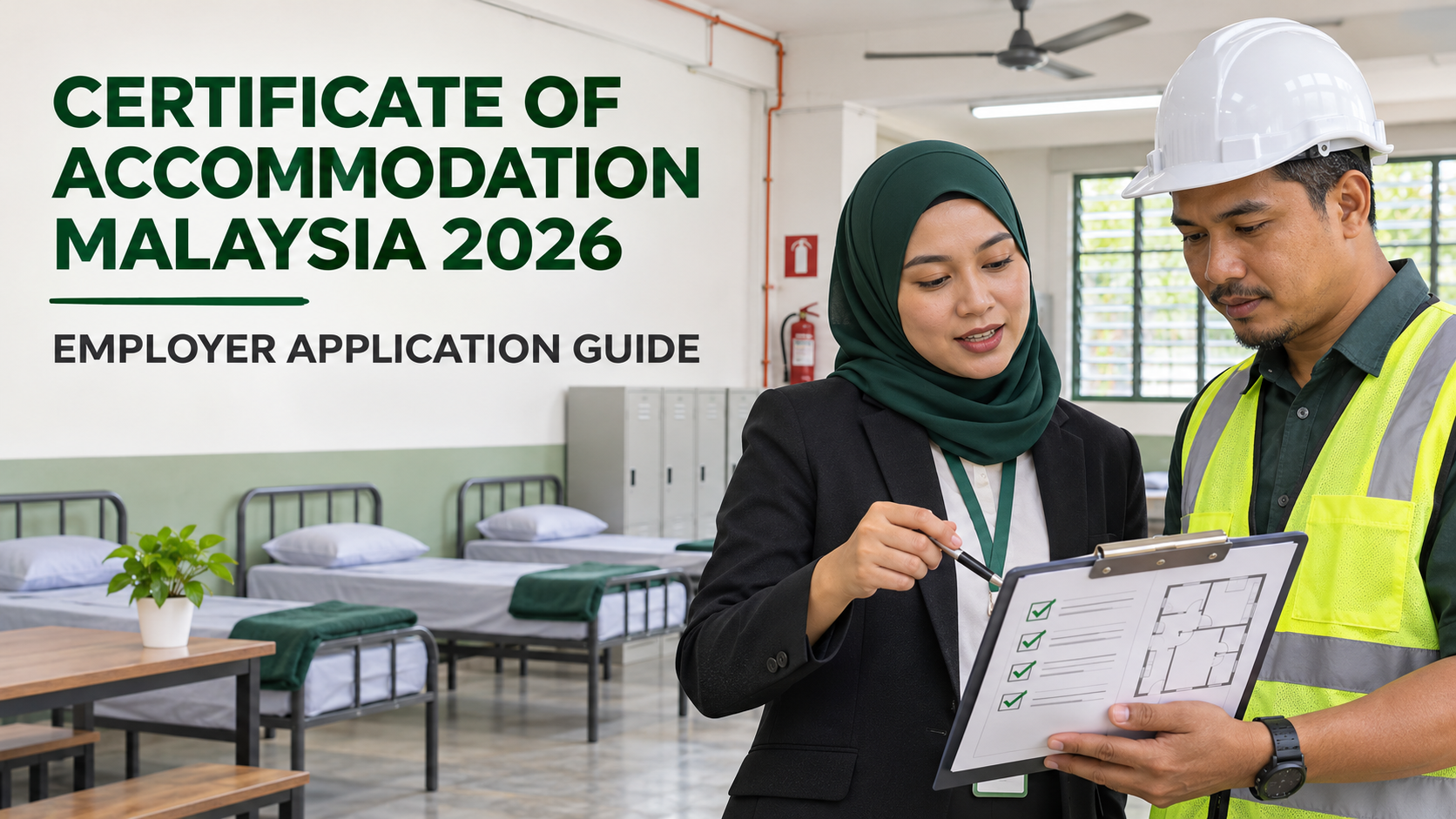
If your company provides accommodation to workers in Peninsular Malaysia or the Federal Territory of Labuan, the premises must have a valid Certificate for Accommodation before workers are placed there. The official English term used in Act 446 is Certificate for Accommodation, although many employers search for Certificate of Accommodation Malaysia.
The certificate is not just paperwork for a building. It confirms that the exact premises have been assessed against the applicable minimum standards for sleeping space, sanitation, beds, utilities and shared facilities. It also connects the approved address and capacity to ongoing duties after occupation.
What is a Certificate for Accommodation
Section 24D of the Employees’ Minimum Standards of Housing, Accommodations and Amenities Act 1990, commonly known as Act 446, states that accommodation must not be provided to an employee unless it has been certified. An employer or a centralised accommodation provider may apply for the certificate.
Act 446 applies in Peninsular Malaysia and the Federal Territory of Labuan. Sabah and Sarawak operate under different legal frameworks. JTKSM also explains that employers of foreign workers must provide accommodation under the applicable regulations.
Who needs to apply
- An employer that houses its own workers applies for the premises it provides.
- A centralised accommodation provider applies for the premises it provides and manages for one or more employers.
- A separate application is required for each accommodation address.
When workers stay at a third party centralised labour quarters, the provider holds the certificate for that building. The employer still has its own duties, including checking the exact address and capacity and notifying JTKSM of worker occupation within 30 days.
How to apply in 2026
1 Confirm the building can be used as worker accommodation
Before applying, obtain the relevant permission or supporting document from the local authority. Depending on the premises, this may involve a temporary building permit, permission to change the building use, renovation approval or another document required for that building category.
2 Check the layout against the minimum standards
Measure the sleeping areas, check the bathroom and toilet ratio, confirm the approved use of each shared area and make sure every required bed, mattress, cupboard and facility can be provided without exceeding capacity.
3 Prepare the supporting documents
The exact checklist depends on whether the premises are rented, self built, purchased, located outside a local authority area, at a construction site or under strata management. Use the current JTKSM checklist for the relevant category.
| Document area | Typical supporting evidence |
| Applicant | SSM registration or other applicable business document |
| Right to use the building | Tenancy agreement, sale and purchase agreement, land title, owner permission or other evidence that matches the building category |
| Building status | Certificate of Fitness, Certificate of Completion and Compliance or relevant local authority permission where applicable |
| Premises details | Floor plan and photographs of the exterior, bedrooms, living area, kitchen, toilets and bathrooms |
| Current premises records | Recent electricity or water bill and assessment tax or equivalent documents listed for the category |
4 Submit the online application for each address
Apply through the official Act 446 application system. Each address is treated as a separate accommodation application, so employers with several locations should keep the documents and capacity records separate.
5 Submit the documents and processing fee
Follow JTKSM instructions for submitting the acknowledgement, supporting documents and prescribed fee to the relevant Labour Office. Check the latest official instructions before payment because administrative procedures can change.
Processing fees
| Applicant | Accommodation capacity | Processing fee |
| Employer | 10 workers or fewer | RM100 |
| Employer | More than 10 workers | RM300 |
| Centralised accommodation provider | 500 workers or fewer | RM2,000 |
| Centralised accommodation provider | More than 500 workers | RM5,000 |
Minimum standards checked for the premises
| Standard | Dormitory accommodation | Non dormitory accommodation |
| Sleeping space | At least 3.0 square metres per worker | At least 3.6 square metres per worker |
| Bathroom and toilet ratio | One for every 15 workers | One for every 6 workers |
Each worker should have the following personal facilities:
- a suitable bed with an area of at least 1.7 square metres;
- a mattress at least 4 inches or 10.2 centimetres thick;
- a pillow and blanket; and
- a lockable cupboard for personal valuables.
Shared facilities include adequate water and electricity, a rest and dining area, kitchen, fans and lighting, clothes drying space, rubbish bins and a first aid kit. A building may look tidy and still fail the capacity or facility requirements, so measurements and the approved layout matter.
What happens after the certificate is issued
Certification is the start of the operating responsibility, not the end. Employers and centralised accommodation providers should keep the premises aligned with the certified address, layout and
capacity and maintain records that reflect actual conditions.
| Ongoing duty | What it means in practice |
| Notify occupation | The employer must notify JTKSM within 30 days from the date workers occupy the premises, including when workers stay in a third party centralised accommodation. |
| Appoint a person in charge | At least one person must be responsible for accommodation management, employee safety and well being and the required amenities. |
| Inspect twice a month | The person in charge must visit and inspect the accommodation at least twice each month and keep a record. |
| Respond to health issues | A worker who complains of illness or appears unwell must be taken to a clinic or hospital, with the complaint recorded. |
| Maintain the premises | Keep the accommodation safe, sanitary and in good repair, and do not allow the actual headcount to exceed the certified capacity. |
The important 2026 accommodation deduction update
From 1 March 2026, the maximum accommodation rent or charge is RM150 per worker per month. This is a ceiling, not an automatic deduction. JTKSM states that a deduction for accommodation cannot be made where the premises do not have a valid Certificate for Accommodation.
The employment contract still controls the agreed amount. If the contract states RM100 or another lower amount, the employer should not increase the deduction to RM150 without first obtaining the worker’s written agreement to change the contract term. If the contract says accommodation is free, no deduction should be made unless the worker has agreed in writing to amend that term.
Other facilities provided inside the accommodation remain the employer’s responsibility and should not be charged separately to the worker.
Penalties should be described accurately
| Offence | Maximum penalty stated in Act 446 |
| Employer provides uncertified accommodation | Fine up to RM50,000 |
| Centralised accommodation provider provides uncertified accommodation | Fine up to RM50,000, imprisonment up to 1 year, or both |
| Employer fails to notify occupation within 30 days | Fine up to RM10,000 |
Different breaches can carry different penalties. Section 24D does not describe the Certificate for Accommodation offence as RM50,000 per worker, so employers should avoid repeating that wording unless another specific provision clearly applies to the situation.
Common questions from employers
- Can workers move in while the application is pending
No. Section 24D requires the accommodation to be certified before it is provided to employees.
- Does one certificate cover several addresses
No. JTKSM’s application guidance requires a separate application for each accommodation address.
- If workers stay in a CLQ does the employer need another certificate The centralised accommodation provider applies for the certificate for that building. The employer should verify the exact premises, validity and capacity and must still submit the occupation notification within 30 days.
- Can an employer deduct RM150 automatically
No. The premises must have a valid certificate and the employment contract must support the deduction. A lower contractual amount or free accommodation term should not be changed without the worker’s prior written agreement.
How BoldExcel supports employers
BoldExcel provides managed foreign worker accommodation and workplace transportation support. Our team helps employers coordinate worker placement, capacity, maintenance, daily transit and accommodation records in a practical arrangement for HR and operations teams.
Sorry, the comment form is closed at this time.